Tuesday, June 17, 2014

June 18, 1864---The Second Battle of Petersburg (Day Four)


JUNE 18, 1864:          
 The Second Battle of Petersburg   (Day Four):  
Robert E. Lee himself arrives on the Petersburg battlefield with two Divisions. P.G.T. Beauregard is furious with Lee. Although he had repeatedly warned Lee of the Federal menace, Lee had ignored or minimized it until his own son, General Rooney Lee, had sent him a private message. The number of Confederate effectives in the lines rises from 14,000 to 20,000 men, but nearly 70,000 Yankees now surround Petersburg. 


The Battle of Jerusalem Road:          
The Union occupies the outer ring of the Dimmock Line, but in attempting to take Battery 27 at the Jerusalem Road, the Federals encounter fierce opposition. 


Colonel Joshua Lawrence Chamberlain, the hero of Little Round Top at Gettysburg, is shot through both hips. Although hip wounds have the highest fatality rates in the Civil War, and although Chamberlain’s medical treatment is worse than medieval (to look for the bullet, Union surgeons run an unsanitized rifle ramrod through one side of his body to another), Chamberlain continues in command of his unit using his ceremonial sword as a walking stick until he faints from blood loss. General Grant, convinced Chamberlain will die, quickly promotes him in the field to Brigadier General. 

Chamberlain does die of his wounds --- in 1914. He is accounted the last combat casualty of the Civil War. Of 900 men in Chamberlain’s 1st Maine, 632 are killed or wounded this day. 


In the Second Battle of Petersburg, total losses for the Union number 11,386 (1,688 killed, 8,513 wounded, 1,185 missing or captured), while Confederate losses are 4,000 (200 killed, 2,900 wounded, 900 missing or captured).


After the Battle of Jerusalem Road, Meade orders his men to entrench. They occupy the outer Dimmock Line, much to the frustration of the Confederates. Due to the trepidation of subordinate commanders though, the Union does not take the city, which 48 hours ago was ready to fall like a ripe apple.  The Second Battle of Petersburg is over, and with it the Overland Campaign. 

The Siege of Petersburg begins in earnest. It will be some 290 days before Old Glory flies above the ruins of Petersburg.

Sunday, June 15, 2014

June 17, 1864---The Second Battle of Petersburg (Day Three); The Battle of Lynchburg, VA


JUNE 17, 1864:           
The Second Battle of Petersburg (Day Three):         
Skirmishing continues around Petersburg. Union troops and Confederate troops continue to arrive from different directions. Although the Federals outnumber the Rebels significantly, no attempts are yet made to isolate the city by surrounding it and cutting its supply lines. The Union does capture more sections of the Dimmock Line, forcing the Rebels into an ever-shrinking pocket around Petersburg.

The Battle of Lynchburg:         
As General David Hunter U.S.A. retreats westward out of the Shenandoah Valley and effectively out of the battle for Virginia, he sacks Lynchburg, Virginia. During the sacking, a Confederate strike force under the dour, humorless, vulgar, messianic but effective General Jubal Early C.S.A. drives him off. The Union loses 75 men out of 17,000. The Confederacy loses 6 out of 14,000.


It is enough for Hunter. He double-times it into West Virginia with Early snapping at his heels like a vicious little dog, covering 60 miles in two days.  Hunter is essentially out of the war. Early takes control of the Valley, and uses it as his unencumbered highway to strike north, deep into Union territory.      


June 16, 1864---The Great Central Sanitary Fair; The Second Battle of Petersburg (Day Two)


JUNE 16, 1864:           
The Second Battle of Petersburg (Day Two):  
General P.G.T Beauregard C.S.A. was to write later of June 16th that Petersburg "at that hour was clearly at the mercy of the Federal commander, who had all but captured it." But General Baldy Smith, the Federal commander on site, does all but capture it. Instead, he waits for reinforcements.

Seeing this, Beauregard acts fast. He orders the troops positioned between The Bermuda Hundred and Petersburg to withdraw to the Dimmock Line surrounding the city.

Had General Benjamin Butler U.S.A. marched his 30,000 man Army of The James on the heels of the suddenly vanishing-Confederate troops that had been blocking his path for weeks, Butler could have easily destroyed them and taken undefended Richmond. Had he done so, it is likely that both Petersburg and Richmond could have fallen in a single day, and the war might have ended with stunning suddenness. But Butler, like Smith, does nothing.  

By midday, Beauregard has 14,000 men holding the Dimmock Line. This is nothing in comparison to the 50,000 Federals that appear in the distance just hours after the Dimmock Line is occupied. Generals Grant and Meade had arrived. When Grant discovered that neither Smith nor Butler had moved aggressively against the paper tiger that was Petersburg, he fumed, but rather than waste time with recriminations he ordered a reconnaissance for weak points in the defensive line. 


Fighting broke out, and the Confederates recaptured a number of battery positions in the line because the Union troops holding the batteries fall back at the first sign of hostility. The Union’s troops are still suffering from what historian James McPherson calls “Cold Harbor Syndrome.” They are hesitant to attack the Confederates in force lest they take brutal casualties.  


President Lincoln addresses the Great Central Sanitary Fair in Philadelphia, Pennsylvania. His speech reads in part:

War, at the best, is terrible, and this war of ours, in its magnitude and in its duration, is one of the most terrible . . . It has carried mourning to almost every home, until it can almost be said that the “heavens are hung in black.” Yet it continues . . . [M]ost is due to the soldier, who takes his life in his hands and goes to fight the battles of his country. In what is contributed to his comfort when he passes to and fro, and in what is contributed to him when he is sick and wounded, whether from the fair and tender hand of woman, or from any other source, is much, very much; but . . . there is still that which has as much value to him . . . that while he is absent he is yet remembered by the loved ones at home---he is not forgotten . . . [W]hen is the war to end? . . . I do not wish to name a day, or month, or a year when it is to end. I do not wish to run any risk of seeing the time come, without our being ready for the end, and for fear of disappointment, because the time had come and not the end. We accepted this war for an object, a worthy object, and the war will end when that object is attained. Under God, I hope it never will until that time. Speaking of the present campaign, General Grant is reported to have said, I am going through on this line if it takes all summer. This war has taken three years . . . I say we are going through on this line if it takes three years more. I have never been in the habit of making predictions in regard to the war, but I am almost tempted to make one — If I were to hazard it, it is this: That Grant is this evening, with General Meade and General Hancock, of Pennsylvania, and the brave officers and soldiers with him, in a position from whence he will never be dislodged until Richmond is taken . . .  

June 15, 1864---The Second Battle of Petersburg (Day One)


JUNE 15, 1864:           
The Second Battle of Petersburg (Day One): 

Ten thousand Union troops under General William F. “Baldy” Smith move against the Confederate defenders of Petersburg. The Confederates have the advantage of formidable physical defenses called the “Dimmock Line,” and they hold off the tepid Union assault of the first day. “Baldy” is convinced that he is facing a force equal to his own. In truth, only 2,300 men are holding the city, all in the fixed forts facing him. Smith squanders a singular offensive opportunity this day by simply not flanking his opponent P.G.T. Beauregard and applying pressure on multiple points at once. When he does move forward on a four mile front, Smith manages to capture fixed Confederate batteries 3, 5, 6, 7, 8, 9, 10, and 11. Despite the ease of taking these positions, Smith still holds back from a full assault. 


Friday, June 13, 2014

June 14, 1864---The Death of The Fighting Bishop


JUNE 14, 1864:            
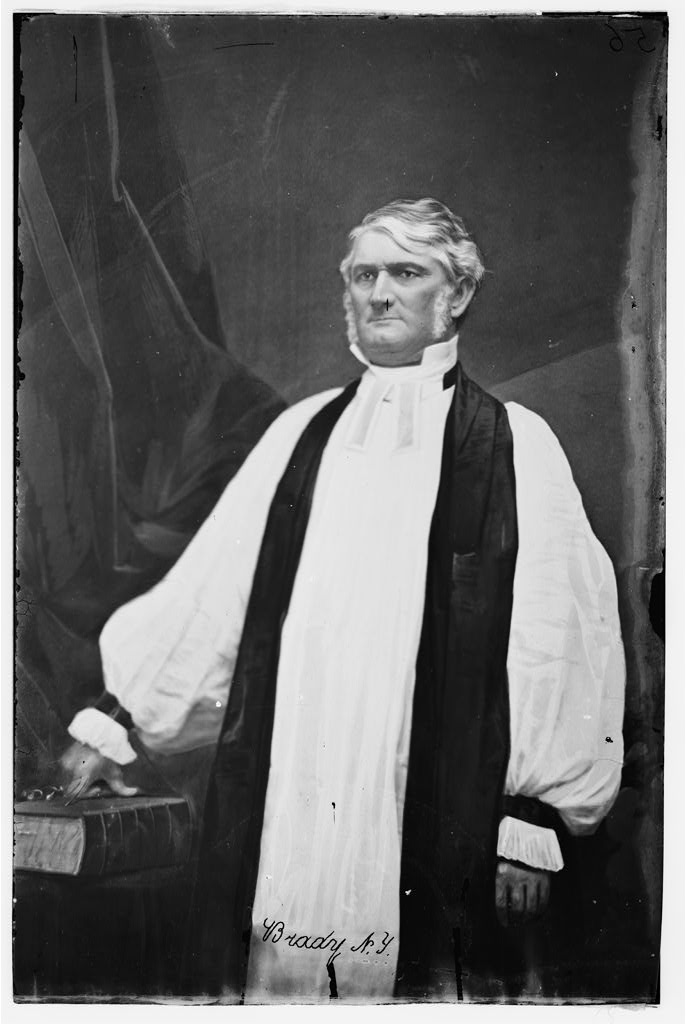
General Leonidas Polk C.S.A. (born 1808) is killed while inspecting relative Confederate and Union positions near Atlanta when he is struck in the chest by a mortar round fired at great distance with amazing accuracy. An ordained Episcopal Bishop and the Bishop of Louisiana, Polk was a run-of-the-mill commander but an inspiring one to his men, able to imbue even routine orders with oratorical fire. As a “political general” (he was related to U.S. President James K. Polk and was close friends with C.S. President Jefferson Davis) he was prone to making errors in the field (such as the one that killed him). He is probably more famous for what he didn’t say than what he said. At the Battle of Perryville (1862), C.S. Major General Benjamin F. Cheatham told his men to "Give 'em hell, boys!" and Polk, ever the model of rectitude, seconded the cheer: "Give it to 'em boys; give 'em what General Cheatham says!" The death of “The Fighting Bishop” made little difference militarily, but the loss of the respected and popular Polk sent a seismic shock through the Confederacy. 
The U.S.S. KEARSARGE drops anchor just outside of Cherbourg, France, waiting for the C.S.S. ALABAMA to leave port. 
Units of The Army of Northern Virginia, moving like lightning, begin to reach Petersburg and occupy the city’s defenses.