Friday, June 7, 2013

May 10, 1861---The St. Louis Riots


MAY 10, 1861:  

 Following the April 25th raid on the St. Louis arsenal by Union forces, pro-Confederate Missouri Governor Claiborne Fox Jackson asks Confederate President Jefferson Davis for heavy artillery with which to attack the St. Louis Arsenal.

On May 1, Jackson calls out the pro-Confederate Missouri Volunteer Militia for maneuvers which take place about 4.5 miles northwest of the arsenal at an encampment christened “Camp Jackson” by the militiamen. 

On May 9, the militiamen receive from Jefferson Davis two 12-pound howitzers, two 32-pound siege guns, 500 muskets, and ammunition. The munitions had been captured by Confederates when they seized the Federal arsenal at Baton Rouge.  Alerted to the presence of the Baton Rouge cargo, Union Captain Nathaniel Lyon began enlisting and arming St. Louis Unionist volunteers, most of whom (80%) were German immigrants, and very unpopular with many native-born Southron Missourians.

Lyon’s 6000 Federals forced the surrender of 669 members of the Missouri Volunteer Militia. The militiamen, however, refused to swear allegiance to the United States. Lyon placed them under arrest and marched them to the arsenal through downtown St. Louis. There, he provided them with a parole and ordered them to disperse.   

The lengthy march was viewed as a public humiliation for the State forces, and pro-Confederate citizens hurled rocks, paving stones, and insults at Lyon’s troops. The heavily German Missouri Volunteer units were particularly targeted by the mob and shouts of “Damn the Dutch” were hurled at them from the crowd.   

After a Federal officer is killed, the Union troops fire into the crowd, killing some 28 people, some of whom are women and children, and wounding as many as 50 more. The incident sparks several days of rioting and anti-German animosity in St. Louis.


May 9, 1861---Harper's Ferry


MAY 9, 1861:        

Robert E. Lee receives and approves Colonel Thomas Jackson’s request for more troops to garrison the arsenal at Harper’s Ferry, Virginia (now West Virginia). However, he denies Jackson’s request to seize the bluffs on the north shore of the Potomac River. The bluffs lie in Maryland, and Lee does not wish to alienate Marylanders, among whom still are a large cadre of secessionists, by invading their State. The bluffs remain in Union hands for the duration of the war.


May 8, 1861---"We need a Dictator."


MAY 8, 1861: 

With Virginia still an independent “republic”, and with the Confederacy less than a month old and still forming, the free press in the South let slip an indicator of domestic instability when the fire-breathing chief newspaper of Virginia’s capital announced:  


          “The Richmond Examiner of to-day demands a Dictator; it says: “No power in executive hands can be too great, no discretion too absolute, at such moments as these. We need a Dictator. Let lawyers talk when the world has time to hear them. Now let the sword do its work. Usurpations of power by the chief, for the preservation of the people from robbers and murderers, will be reckoned as genius and patriotism by all sensible men in the world now, and by every historian that will judge the deed hereafter.”


          Although the call for a Southern dictatorship went unheeded in 1861, this became a repeating theme in the press as the war progressed and Southern fortunes declined. 

Usually, Robert E. Lee was named as the preferred man for the job; Lee refused to consider any such thing.


May 7, 1861---Tennessee secedes; the Confederacy fights the Union Blockade


MAY 7, 1861: 

The Battle of Gloucester Point, Virginia. An inconclusive exchange of cannon fire between a Virginia shore battery on the York River and the gunboat U.S.S. YANKEE marks the beginning of Confederate resistance to the Union’s announced sea blockade of the C.S.A. 


On this same day, Tennessee secedes from the Union.

May 6, 1861---Arkansas leaves the Union


MAY 6, 1861:      

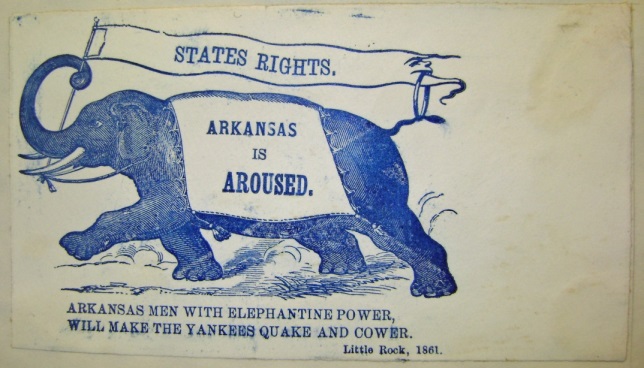
 Arkansas secedes from the Union. 


[Interestingly, this broadside of the time features an elephant, a later symbol of the then despised anti-Confederate Republican Party, and the color blue, today a modern color of the then Confederate-friendly Democratic Party]