Friday, June 13, 2014

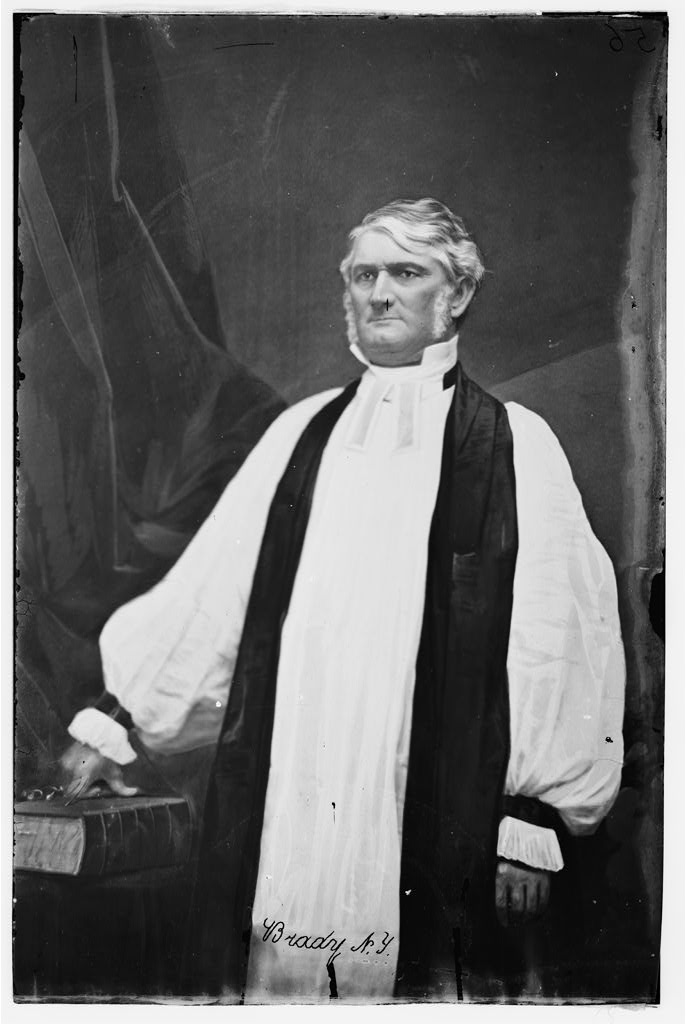
June 14, 1864---The Death of The Fighting Bishop


JUNE 14, 1864:            
General Leonidas Polk C.S.A. (born 1808) is killed while inspecting relative Confederate and Union positions near Atlanta when he is struck in the chest by a mortar round fired at great distance with amazing accuracy. An ordained Episcopal Bishop and the Bishop of Louisiana, Polk was a run-of-the-mill commander but an inspiring one to his men, able to imbue even routine orders with oratorical fire. As a “political general” (he was related to U.S. President James K. Polk and was close friends with C.S. President Jefferson Davis) he was prone to making errors in the field (such as the one that killed him). He is probably more famous for what he didn’t say than what he said. At the Battle of Perryville (1862), C.S. Major General Benjamin F. Cheatham told his men to "Give 'em hell, boys!" and Polk, ever the model of rectitude, seconded the cheer: "Give it to 'em boys; give 'em what General Cheatham says!" The death of “The Fighting Bishop” made little difference militarily, but the loss of the respected and popular Polk sent a seismic shock through the Confederacy. 
The U.S.S. KEARSARGE drops anchor just outside of Cherbourg, France, waiting for the C.S.S. ALABAMA to leave port. 
Units of The Army of Northern Virginia, moving like lightning, begin to reach Petersburg and occupy the city’s defenses. 

June 13, 1864---On to Petersburg


JUNE 13, 1864:

After a refit, the U.S.S. KEARSARGE leaves Dover, England in the U.K. to hunt for the notorious C.S.S. ALABAMA. 


Since July 29, 1862, the ALABAMA --- a Confederate ship that has never entered a Confederate port, having been built in Liverpool --- has been commerce raiding with impunity against Union merchant vessels (and an occasional U.S. Naval vessel) over three-quarters of the surface of the earth. In total, she took 65 prizes, including U.S.S. HATTERAS, and commissioned one progeny, C.S.S. TUSCALOOSA, that took two more.

Except for brief liberty calls, the ship has been at sea for two years. She is sea-battered, her rigging is loose, her hull is barnacled, and she has lost most of her fabled speed.

Captain Raphael Semmes brings her into the Port of Cherbourg for an overhaul on June 11th, but the French have not been welcoming. Semmes is attempting to negotiate for a drydock. He knows the KEARSARGE is not far away, and soon the Union ship will take up station just beyond the limits of French territorial waters waiting for her nemesis to put out to sea again. 


In Virginia, Robert E. Lee receives Intelligence that Ulysses S. Grant is bypassing Richmond to invest Petersburg. Lee knows that if Petersburg, Richmond’s supply depot, rail hub, and link to the rest of the Confederacy falls, the war will be as good as over. Lee hurriedly orders 2,300 men --- all he can muster in a hurry --- to ride for Petersburg and occupy the defensive works there that ring the city. Knowing that 2,300 men can be overrun by the massive Army of The Potomac in an eyeblink, Lee engages in a little disinformation and psyops campaign. He arranges for several slaves to be allowed to escape their masters each carrying the news that there are 10,000 men in the Petersburg revetments. Although it is not known for a certainty that the slaves knew the information was false, given the attitude of most southerners toward blacks and the mistrust they felt, it’s likely that the escaped slaves were unaware that the information was false. 


Ares the God of War smiles on Lee when the first Union Commander to reach Petersburg is William “Baldy” Smith, the same General that risked a court-martial in refusing Grant’s orders to renew the attack on Cold Harbor’s earthworks. Once Smith views the Petersburg defenses and hears the slaves’ reports, he decides to do what Grant had done initially at Cold Harbor --- wait for reinforcements. Although this seems wise, the delay prolongs the war for months. The first prong of Grant’s planned three-pronged encirclement of Petersburg is dulled. 

 
In western Virginia, Philip Sheridan rides away from Trevilian Station, hoping to link up with Union forces in the Shenandoah Valley. The last word from the commander there, General David Hunter, is that he has taken Lexington, Virginia and burned the Virginia Military Institute to the ground the day before. After destroying the hallowed site, Hunter is engaged by Confederate cavalry, Mosby’s Rangers, and irregulars. Although Hunter’s force numbers almost 20,000 he decides to retreat west toward friendly territory in West Virginia, rather than moving east toward his expected rendezvous with Sheridan. The second prong of Grant’s planned three-pronged encirclement of Petersburg is broken.

In eastern Virginia, General Benjamin Butler U.S.A. moves toward a planned consolidation with Grant’s forces at a tepid pace. Any Confederate resistance causes him to stop, regather his forces, and creep forward again. By the time the linkage occurs, Lee’s men will be safely inside Petersburg. The third prong of Grant’s planned three-pronged encirclement of Petersburg is bent. 


Had Grant’s subordinates moved with purpose, it is quite possible that The Army of Northern Virginia would have been encircled by midmonth, and that Grant could have forced a surrender --- and the effective end of the war --- by July 1st. However, among Lincoln’s generals, only Ulysses S. Grant is unawed by the legendary Virginian. 


Many historians have commented on Lee’s seemingly amazing ability to outmaneuver The Army of The Potomac. The reasons are many, but relatively simple: 


1. The Army of Northern Virginia was operating on shorter interior lines in friendly territory. Lee had the ability, when marching on Petersburg to move through Richmond. Grant and The Army of The Potomac were forced to operate on lengthier exterior lines, moving around and bypassing most crossroads. 


2. The Army of The Potomac was forced to keep to the rivers and rail lines where they could maintain their ever more thinly stretched supply lines. On average, the Army of The Potomac had to march three times the distance as the Army of Northern Virginia in order to reach the same objectives. 


3. The Army of Northern Virginia was half the size of the Army of The Potomac, with less gear, and hence able to break camp and move far more quickly than the larger force. Also, The Army of Northern Virginia was made up entirely of tried soldiery, many having fought in the ranks since 1861, and intimately familiar with on-the-march procedures. Muscle memory was an important if unrecognized element in Lee’s success. The Army of The Potomac had more, if not a lot of, less-experienced men in the summer of 1864, men who were less familiar with on-the-march procedures. General Grant, for example, filled the ranks with garrison soldiers from Washington in order to besiege Petersburg. Many of these men had never seen real combat or been in the field since the war began. Multiplied many times, the small lags caused by the uncertain actions of such troops created a fairly large distortion factor in moving the army. 

 
In sum, Lee could move his forces four to five times faster than Grant, so even a multi-day delay in mobilizing his army meant that Lee could usually get where he was going far faster than Grant, as he consistently did during the Overland Campaign. 


Wednesday, June 11, 2014

June 12, 1864---The Battle of Trevilian Station (Day Two)


JUNE 12, 1864:                
The Battle of Trevilian Station  (Day Two):          
General Philip Sheridan U.S.A. renews the attack on C.S. Generals Wade Hampton and Fitzhugh Lee, whose men are fighting from entrenchments. Sheridan is forced to dehorse his men who approach the Confederate lines on foot. The expectable happens. The entrenched Confederates blast holes in the Union lines.

Although this is not Cold Harbor nor The Bloody Angle, the battle costs Sheridan 735 killed, wounded and missing. Confederate losses are at least 1,000. After darkness, Sheridan decides that he is victorious, and his men mount up and ride off. Within three days, the Virginia Central R. R. is delivering supplies to The Army of Northern Virginia. 


The Battle of Cold Harbor      (Day Thirteen):    Grant gives the order for The Army of The Potomac to move on Petersburg. Their immediate destination is the James River, Robert E. Lee’s “red line” after which “it will only be a matter of time.” The Union crosses the wide river on a 2,100 foot long pontoon bridge. 


While Grant’s men are undoubtedly thanking God that they can finally abandon their heartbreaking trenches at Cold Harbor, it is a bedraggled, befouled, and mentally exhausted force that begins moving south. Almost two weeks in the trenches following the slaughter of June 3rd has not improved the army’s morale. The force that cheered Grant after the brutal Battle of The Wilderness is a grumbling, swearing mass of men with no taste for any further combat. Individual men --- even whole units --- are refusing orders.

Part of the problem is that for the Union Army the end of the Battle of Cold Harbor coincides with the expiration of the first of the mass of three year enlistments of 1861. Many, too many, men are dead. A good part of the survivors are short-timers, who are refusing to risk their lives in what has become, and is apparently going to remain, an abattoir. Almost 200,000 men of the Union’s total strength of 300,000 are looking forward to their discharge papers. 


All sorts of inducements --- signing bonuses, higher pay, extra stripes, field commissions, 90-day furloughs, drink, prostitutes, and even threats --- are being offered to encourage men to re-enlist. Briefer enlistment periods are promised, and better conditions. “The war will be over soon!” is a promise repeated thousands of times. In the end, 110,000 Union soldiers choose to stay and fight.  The Federal government begins to organize a summer draft.


Lee has a similar but far more insoluble problem. He has reached the bottom of his manpower barrel and needs men desperately. But there is nobody to cajole, no bonuses to pay, no better food, no pool of draftees; there is nothing to be done but fight on with his increasingly gaunt armies. Exactly when Lee realizes that the war will end in a Confederate defeat is unknown. Right now, he is outwardly concerned about what he assumes will be Grant’s battle for Richmond.   
In the interests of history, disregard the disclaimer you will see when you click this link, and listen to the rare full version of this song. The disclaimer is the kind of Politically Correct stupidity that makes me furious. While posting tonight's "Civil War Timeline," I included this link to the song "Bonnie Blue Flag," one of the two unofficial anthems of the Confederacy (the other is "Dixie"). Click on the link and it will give you a warning about "Offensive and inappropriate content" before you hear the song. All there is is a video (with some nice artwork) and the song (with full lyrics). Yes, there are Confederate flags in the video --- it's a Confederate song, after all!  But how is displaying a Confederate flag in proper historical context "offensive" or "inappropriate"?  That's precisely the proper place for them.  The poster includes a blurb that talks of "heritage." Forget that. But "history" is another matter. All Americans share the history of the Civil War by dint of just being Americans --- Konrei

Tuesday, June 10, 2014

June 11, 1864---The Battle of Trevilian Station (Day One)


JUNE 11, 1864:            
The Battle of Trevilian Station  (Day One):   
Ulysses S. Grant, having decided to abandon his position at Cold Harbor and flank around Richmond on his way toward Petersburg, dispatches Philip Sheridan, his cavalry commander, to ride towards Charlottesville in force and cut the Virginia Central Railroad. The line is Robert E. Lee's main supply source. 

After cutting the railroad, Sheridan is then supposed to enter the Shenandoah Valley, link up with Union forces there, and lead the combined force back to Petersburg.
Sheridan duly swings north around Richmond and heads toward Charlottesville, 60 miles away.
General Wade Hampton C.S.A., is reputedly the richest man in the Confederacy and already the proud but grim possessor of three battle wounds. Lee has named him the new commander of the Confederate cavalry, succeeding General James Ewell Brown (“Jeb”) Stuart, who had been killed just exactly a month before at Yellow Tavern. 
General Wade Hampton, C.S.A.
Hampton sets out to intercept Sheridan with 10,000 cavalrymen, the exact number led by Sheridan. Although Sheridan has a two day head start, again, the Rebs make better time than the Yankees, and Hampton reaches the Trevilian area on June 10, one day ahead of the Union column.
Early on this day, Hampton engages portions of Sheridan’s forces and in stubborn fighting pushes them back up the Trevilian Station Road. While this is happening, General George A. Custer's brigade engages General Fitzhugh Lee’s men on the Louisa Court House Road, a few miles to the east. Fitzhugh Lee is forced to retreat, and Custer exploits the dangerous gap between Lee and Hampton, capturing Hampton's wagon train, 800 horses, and three caissons parked behind the Confederate lines. He takes Trevilian Station.
General Fitzhugh Lee, C.S.A.
Hampton rushes to Lee’s defense, plugs the gap, and together Hampton and Lee surround Custer’s force in what is later sardonically referred to as  'Custer's First Last Stand'. To relieve Custer's hard-pressed brigade, Sheridan must attack Hampton, who, for a time, retreats out of the battle. Sheridan’s men spend the rest of the day disabling the railroad. 
The Battle of Cold Harbor (Day Twelve):       
While Sheridan’s men are fighting at Trevilian Station, other units of The Army of The Potomac link up with The Army of The James. General Butler orders an advance, but it begins at a snail-like pace.