Tuesday, June 10, 2014

June 11, 1864---The Battle of Trevilian Station (Day One)


JUNE 11, 1864:            
The Battle of Trevilian Station  (Day One):   
Ulysses S. Grant, having decided to abandon his position at Cold Harbor and flank around Richmond on his way toward Petersburg, dispatches Philip Sheridan, his cavalry commander, to ride towards Charlottesville in force and cut the Virginia Central Railroad. The line is Robert E. Lee's main supply source. 

After cutting the railroad, Sheridan is then supposed to enter the Shenandoah Valley, link up with Union forces there, and lead the combined force back to Petersburg.
Sheridan duly swings north around Richmond and heads toward Charlottesville, 60 miles away.
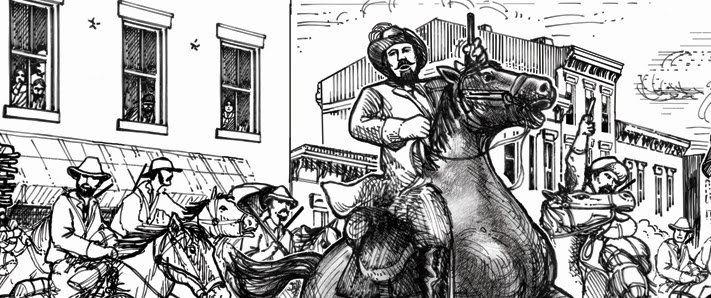
General Wade Hampton C.S.A., is reputedly the richest man in the Confederacy and already the proud but grim possessor of three battle wounds. Lee has named him the new commander of the Confederate cavalry, succeeding General James Ewell Brown (“Jeb”) Stuart, who had been killed just exactly a month before at Yellow Tavern. 
General Wade Hampton, C.S.A.
Hampton sets out to intercept Sheridan with 10,000 cavalrymen, the exact number led by Sheridan. Although Sheridan has a two day head start, again, the Rebs make better time than the Yankees, and Hampton reaches the Trevilian area on June 10, one day ahead of the Union column.
Early on this day, Hampton engages portions of Sheridan’s forces and in stubborn fighting pushes them back up the Trevilian Station Road. While this is happening, General George A. Custer's brigade engages General Fitzhugh Lee’s men on the Louisa Court House Road, a few miles to the east. Fitzhugh Lee is forced to retreat, and Custer exploits the dangerous gap between Lee and Hampton, capturing Hampton's wagon train, 800 horses, and three caissons parked behind the Confederate lines. He takes Trevilian Station.
General Fitzhugh Lee, C.S.A.
Hampton rushes to Lee’s defense, plugs the gap, and together Hampton and Lee surround Custer’s force in what is later sardonically referred to as  'Custer's First Last Stand'. To relieve Custer's hard-pressed brigade, Sheridan must attack Hampton, who, for a time, retreats out of the battle. Sheridan’s men spend the rest of the day disabling the railroad. 
The Battle of Cold Harbor (Day Twelve):       
While Sheridan’s men are fighting at Trevilian Station, other units of The Army of The Potomac link up with The Army of The James. General Butler orders an advance, but it begins at a snail-like pace.

Monday, June 9, 2014

June 10, 1864---The Battle of Brice's Crossroads


JUNE 10, 1864:           
The Battle of Brice’s Crossroads:      
Far away from Virginia, General Joseph E. Johnston C.S.A. and General William Tecumseh Sherman U.S.A. are continuing their armed debate over the ownership of Atlanta. While the Atlanta Campaign has not been a cakewalk for either side, it has not been another Overland Campaign. Where Lee is brash, Johnston is cautious. Where Grant is forthright and grasps the nettle, Sherman is crafty and backs his opponent into a briar patch. Thus, the Atlanta Campaign has had a few large battles, but it mostly consists of maneuvers which are pushing Johnston back toward Atlanta. But Sherman has a problem far in his rear. In Mississippi, General Nathan Bedford Forrest C.S.A. and his free-ranging cavalry command (his “critter companies”) have been raiding Union supply depots, cutting telegraph wires, and disrupting Sherman’s rail connections. Today, Sherman orders 8,000 Union troops led by General Samuel Sturgis and General Benjamin Grierson to punish Forrest. Forrest’s force numbers less than 5,000. The two small armies meet at Brice’s Crossroads not far from Tupelo, Mississippi. The battle, which begins at 9:45 A.M. ends in a Union rout by 4:00 P.M.  The Union loses 2,240 men (1,500 captured), while the Confederates lose 492 overall. Forrest also seizes a desperately-needed cornucopia of Union supplies including heavy ordnance: a 3-inch rifled steel gun, three 6-pounder rifled bronze guns, two 4-inch rifled bronze guns, five 6-pounders, two 12-pounders, and three 12-pounder Napoleon guns, along with ammunition, powder, food stocks, small firearms and bullets, and horses. Forrest is jubilant. Sturgis gets busted to Colonel and is sent to a quiet frontier post where he fades into obscurity. 
The Battle of Cold Harbor  (Day Eleven):        
Having finalized his strategy for the next step of the Overland Campaign, Grant has dispatched troops to cut the railways, link up with Union forces in the Shenandoah Valley, and link up with “Beast” Butler, still encamped at The Bermuda Hundred. It is Grant’s plan to bypass Richmond and fall upon Petersburg. Grant calculates that if he can seize Petersburg, the gateway and supply depot to Richmond, he can force an end to the war by month’s end. At first, his plan goes flawlessly. Robert E. Lee is not even aware that units of The Army of The Potomac are on the move.    

Sunday, June 8, 2014

June 9, 1864---The Battle of Old Men and Young Boys


JUNE 9, 1864:              
The Battle of Old Men and Young Boys (The First Battle of Petersburg):
What becomes the Siege of Petersburg, Virginia begins even while Grant and Lee are engaged in the trenches at Cold Harbor. General Benjamin “Beast” Butler U.S.A’s Army of The James makes a foray toward Petersburg. Butler finds the complex entrenchments around the city manned by a single Brigade of Virginia State Militia made up of adolescents and men in their sixties. Amazingly, the old men and young boys drive Butler’s troops off. The Union troops return all the way to their base in The Bermuda Hundred.


The Battle of Old Men and Young Boys has two results. First, it makes Grant question Butler’s competence and will to fight (both already under scrutiny). Second, it alerts the Confederates as to just how weak the Petersburg defenses really are. Lee begins sending reinforcements to Petersburg almost literally at the moment that Grant decides to bypass Richmond and take lightly-defended Petersburg instead. In the end, Butler’s staggering ineptitude in fighting a token force undoubtedly lengthens the war. 

The Battle of Cold Harbor  (Day Ten):             
The brutal fire across No-Man’s Land continues. Both Lee and Grant are sacrificing men every day just to stay in place. Robert E. Lee is chafing under these conditions. He realizes that an all-out attack on the Union entrenchments will end in a bloody Confederate debacle identical to the Union’s June 3rd disaster, and that such a debacle will spell the end the war. The Union will be victorious.

Lee also knows in his gut that the Union Army must be stopped here and now or probably not at all. Lee says: “We must destroy this army of Grant’s before he gets to the James River.  If he gets there, then it will be a siege, and then it will be a mere question of time.” 

Lee faced this same dilemma in 1862. Cold Harbor is hard by Gaines’ Mill where he and McClellan had battled it out in that seemingly long-ago summer. McClellan had retreated practically to Paris after Lee had handed him a stinging but mild defeat. Grant is not McClellan. Grant seems only to gain more resolve from each setback. Lee knows he is facing a different kind of enemy now.  And Lee knows he is being backed into a corner, however it looks.

In 1864, the battlefield positions of the Union and Confederate forces are exactly reversed from those of 1862. 
Old Cold Harbor Inn

Interestingly, neither Cold Harbor --- Old or New --- is a harbor, and neither has water access. The word “harbor” is used here in its older sense as “a place of shelter” or a “hold” (as in “harboring a grudge”). The “Harbors” were two inns owned by Isaac Burnett, who, innkeeper though he was, was not known for his bonhomie in either his older establishment or his newer.


As was common in those days, small crossroads towns had grown up around the two inns, and now a complex of trenches stretched between them.  
This aerial photograph of the trenches on the 1916 Western Front in World War I gives some idea of the appearance of the countryside around Cold Harbor in 1864

The dead are buried underfoot or in shallow graves along the margins of No-Man’s Land. The Spring rain washes the remains out of their uneasy resting places making the already macabre battlefield a place of searing nightmares.
The exhumed dead at Cold Harbor

June 8, 1864---The Battle of Cold Harbor (Day Nine)


JUNE 8, 1864:            
The Battle of Cold Harbor  (Day Nine):     
Exchanges of gunfire and artillery mark this day at Cold Harbor. Grant is sequestered with Meade and his other commanders, calculating the next move in the Overland Campaign. Conditions in the trenches continue to deteriorate.
Immediately after his renomination, President Lincoln announces his support for a Constitutional Amendment banning slavery.  The Republican Convention also endorses the “unconditional surrender” of the Rebels as the only acceptable resolution of the war.
The New York Times, ever friendly to Lincoln, editorializes: "The country may rely, with unfaltering trust, upon the supreme devotion of the President to the defence of the Government and the suppression of the rebellion."
In Mount Sterling Kentucky, John Hunt Morgan’s raiders defeat a small Union garrison. For good (or bad) measure, they rob the town bank. It says much of the state of the Confederacy that even Morgan’s disciplined strike force is being reduced to brigandage.