Monday, June 9, 2014

June 10, 1864---The Battle of Brice's Crossroads


JUNE 10, 1864:           
The Battle of Brice’s Crossroads:      
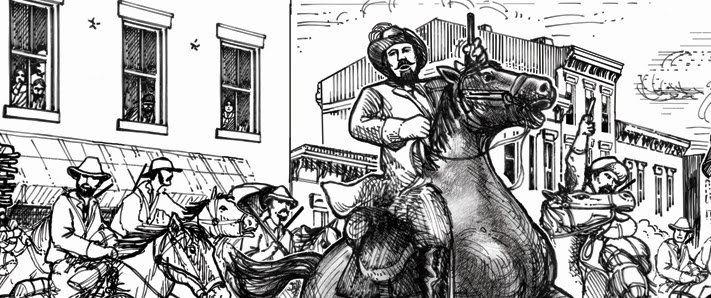
Far away from Virginia, General Joseph E. Johnston C.S.A. and General William Tecumseh Sherman U.S.A. are continuing their armed debate over the ownership of Atlanta. While the Atlanta Campaign has not been a cakewalk for either side, it has not been another Overland Campaign. Where Lee is brash, Johnston is cautious. Where Grant is forthright and grasps the nettle, Sherman is crafty and backs his opponent into a briar patch. Thus, the Atlanta Campaign has had a few large battles, but it mostly consists of maneuvers which are pushing Johnston back toward Atlanta. But Sherman has a problem far in his rear. In Mississippi, General Nathan Bedford Forrest C.S.A. and his free-ranging cavalry command (his “critter companies”) have been raiding Union supply depots, cutting telegraph wires, and disrupting Sherman’s rail connections. Today, Sherman orders 8,000 Union troops led by General Samuel Sturgis and General Benjamin Grierson to punish Forrest. Forrest’s force numbers less than 5,000. The two small armies meet at Brice’s Crossroads not far from Tupelo, Mississippi. The battle, which begins at 9:45 A.M. ends in a Union rout by 4:00 P.M.  The Union loses 2,240 men (1,500 captured), while the Confederates lose 492 overall. Forrest also seizes a desperately-needed cornucopia of Union supplies including heavy ordnance: a 3-inch rifled steel gun, three 6-pounder rifled bronze guns, two 4-inch rifled bronze guns, five 6-pounders, two 12-pounders, and three 12-pounder Napoleon guns, along with ammunition, powder, food stocks, small firearms and bullets, and horses. Forrest is jubilant. Sturgis gets busted to Colonel and is sent to a quiet frontier post where he fades into obscurity. 
The Battle of Cold Harbor  (Day Eleven):        
Having finalized his strategy for the next step of the Overland Campaign, Grant has dispatched troops to cut the railways, link up with Union forces in the Shenandoah Valley, and link up with “Beast” Butler, still encamped at The Bermuda Hundred. It is Grant’s plan to bypass Richmond and fall upon Petersburg. Grant calculates that if he can seize Petersburg, the gateway and supply depot to Richmond, he can force an end to the war by month’s end. At first, his plan goes flawlessly. Robert E. Lee is not even aware that units of The Army of The Potomac are on the move.    

Sunday, June 8, 2014

June 9, 1864---The Battle of Old Men and Young Boys


JUNE 9, 1864:              
The Battle of Old Men and Young Boys (The First Battle of Petersburg):
What becomes the Siege of Petersburg, Virginia begins even while Grant and Lee are engaged in the trenches at Cold Harbor. General Benjamin “Beast” Butler U.S.A’s Army of The James makes a foray toward Petersburg. Butler finds the complex entrenchments around the city manned by a single Brigade of Virginia State Militia made up of adolescents and men in their sixties. Amazingly, the old men and young boys drive Butler’s troops off. The Union troops return all the way to their base in The Bermuda Hundred.


The Battle of Old Men and Young Boys has two results. First, it makes Grant question Butler’s competence and will to fight (both already under scrutiny). Second, it alerts the Confederates as to just how weak the Petersburg defenses really are. Lee begins sending reinforcements to Petersburg almost literally at the moment that Grant decides to bypass Richmond and take lightly-defended Petersburg instead. In the end, Butler’s staggering ineptitude in fighting a token force undoubtedly lengthens the war. 

The Battle of Cold Harbor  (Day Ten):             
The brutal fire across No-Man’s Land continues. Both Lee and Grant are sacrificing men every day just to stay in place. Robert E. Lee is chafing under these conditions. He realizes that an all-out attack on the Union entrenchments will end in a bloody Confederate debacle identical to the Union’s June 3rd disaster, and that such a debacle will spell the end the war. The Union will be victorious.

Lee also knows in his gut that the Union Army must be stopped here and now or probably not at all. Lee says: “We must destroy this army of Grant’s before he gets to the James River.  If he gets there, then it will be a siege, and then it will be a mere question of time.” 

Lee faced this same dilemma in 1862. Cold Harbor is hard by Gaines’ Mill where he and McClellan had battled it out in that seemingly long-ago summer. McClellan had retreated practically to Paris after Lee had handed him a stinging but mild defeat. Grant is not McClellan. Grant seems only to gain more resolve from each setback. Lee knows he is facing a different kind of enemy now.  And Lee knows he is being backed into a corner, however it looks.

In 1864, the battlefield positions of the Union and Confederate forces are exactly reversed from those of 1862. 
Old Cold Harbor Inn

Interestingly, neither Cold Harbor --- Old or New --- is a harbor, and neither has water access. The word “harbor” is used here in its older sense as “a place of shelter” or a “hold” (as in “harboring a grudge”). The “Harbors” were two inns owned by Isaac Burnett, who, innkeeper though he was, was not known for his bonhomie in either his older establishment or his newer.


As was common in those days, small crossroads towns had grown up around the two inns, and now a complex of trenches stretched between them.  
This aerial photograph of the trenches on the 1916 Western Front in World War I gives some idea of the appearance of the countryside around Cold Harbor in 1864

The dead are buried underfoot or in shallow graves along the margins of No-Man’s Land. The Spring rain washes the remains out of their uneasy resting places making the already macabre battlefield a place of searing nightmares.
The exhumed dead at Cold Harbor

June 8, 1864---The Battle of Cold Harbor (Day Nine)


JUNE 8, 1864:            
The Battle of Cold Harbor  (Day Nine):     
Exchanges of gunfire and artillery mark this day at Cold Harbor. Grant is sequestered with Meade and his other commanders, calculating the next move in the Overland Campaign. Conditions in the trenches continue to deteriorate.
Immediately after his renomination, President Lincoln announces his support for a Constitutional Amendment banning slavery.  The Republican Convention also endorses the “unconditional surrender” of the Rebels as the only acceptable resolution of the war.
The New York Times, ever friendly to Lincoln, editorializes: "The country may rely, with unfaltering trust, upon the supreme devotion of the President to the defence of the Government and the suppression of the rebellion."
In Mount Sterling Kentucky, John Hunt Morgan’s raiders defeat a small Union garrison. For good (or bad) measure, they rob the town bank. It says much of the state of the Confederacy that even Morgan’s disciplined strike force is being reduced to brigandage. 

Friday, June 6, 2014

June 7, 1864---Lincoln is renominated for President; Grim numbers

JUNE 7, 1864:             

The Republican National Convention, meeting in Baltimore, Maryland, nominates Abraham Lincoln and Andrew Johnson as its Presidential candidates.

A rump Radical Republican convention nominates John C. Fremont for President. This splits the Republican ticket --- a bad augury. 

In the mid-19th Century, Presidents rarely served more than one term. William Henry Harrison and Zachary Taylor had both died while in office. Taylor's successor, Millard Fillmore, was not renominated. Neither were John Quincy Adams, Martin Van Buren, James K. Polk, Franklin Pierce, or James Buchanan. So Lincoln is swimming against the tide of the history of his time. 

Lincoln has been an inspiring leader, but no President has ever been more viciously attacked during his incumbency than Lincoln. Whether it is a matter of military significance such as appointing Grant, a matter of social significance such as emancipating the slaves, or a minor matter of personal choice such as which gloves he will wear to the opera, Lincoln cannot escape criticism and direct insult. He is even mocked for wearing his trademark stovepipe hat.


Yet, “The original gorilla” is a consummate politician and a visionary. Though his decisions often flummox both friend and foe and seem wrong in the short term, Lincoln’s vision for the long term is nearly flawless. His major gaffe has been his insistence on seeking a way to resettle the newly-freed blacks outside of the United States. 

In asking Andrew Johnson of Tennessee to be his running mate he makes another fateful mistake. On paper, Johnson is the perfect Vice-President, a loyal Southern War Democrat, the only Southern Senator to remain a Unionist during the war. Lincoln jettisons Maine native Hannibal Hamlin from the ticket in favor of Johnson because Lincoln wants the South to see that his second Administration will one of national reconciliation, not a sectional hornet’s nest.

As a stumping candidate, Johnson is problematical. He is a severe alcoholic, often incoherent, and extremely liable to be indiscreet.  He has all the racial prejudices of his time. Worse yet, he is vindictive and just as vengeful toward Southerners (whom he sees as disloyal) as any Radical Republican. He is reflexively antagonistic toward Northerners (whom he sees as Abolitionists). Despite this, he likes and is personally loyal to the President, and Lincoln assumes that he can keep “Old Andy” on a short tether. Still, "This Johnson is a queer man," Lincoln laments.


The Battle of Cold Harbor      (Day Eight):    The misery in the trenches continues. By this time, the Union entrenchments are as convoluted as the Confederacy’s. 


The Overland Campaign has been effective but brutally costly:

·  The Confederacy inflicts 72,000 casualties on the Union. The Union inflicts 45,000 casualties on the Confederacy. Thus, the Union loses 27,000 more men during the Campaign than does the Confederacy. But these numbers tell only a part of the story ---

·  The most recent statistics have found that Civil War losses are over 700,000. Losses for both sides during the Overland Campaign and the Atlanta campaign (to date) are 120,000. Thus, almost eighteen percent of all Civil War losses occur in one month, between May 1st and June 6, 1864.

· In the weeks beginning May 1st and ending June 6th, the Union sustains 72,000 casualties out of a total effective force of 300,000. In other words, roughly one out of four men in the army as of April 30th is wounded or killed in the month of May 1864.

· Almost all these losses (60,000 for Grant and 10,000 for Sherman) are sustained either in the Overland Campaign or in the Atlanta Campaign. As a combined force, Grant and Sherman have 2/3rds of the army’s manpower (200,000 men). Thus, the Overland and Atlanta Campaigns together cost the army 70,000 out of 200,000 men engaged --- a 33% loss rate.

·  At the close of the Overland Campaign, Grant and Sherman have 130,000 effectives remaining in their combined force. They also have 100,000 men in other Commands available from outside of their combined force. In total, the Union Army has 230,000 men at the end of the Overland Campaign, plus an undrafted reserve (the August draft will call for 500,000 more men).
 
Contrast this with the Confederacy:   

In the weeks beginning May 1st and ending June 6th, the Confederacy sustains 45,000 casualties out of a total effective force of 150,000. In other words, roughly one out of three men in the army as of April 30th is wounded or killed in the month of May 1864.  

Almost all these losses (42,000 for Lee and 3,000 for Johnston) are sustained either in the Overland Campaign or in the Atlanta Campaign. As a combined force, Lee has more than 1/3rd of the army’s manpower (60,000 men) and Johnston has somewhat less than a third (40,000 men). Thus, the Overland and Atlanta Campaigns together cost the army 45,000 out of 100,000 men engaged --- a 45% loss rate. 

At the close of the Overland Campaign, Lee and Johnston have 55,000 effectives remaining in their combined force. They also have 50,000 men in other Commands available from outside of their combined force. In total, the Confederate Army has 105,000 men at the end of the Overland Campaign. All white men fit for duty in the Confederacy are under arms; there is no undrafted reserve. The Confederacy will not begin manumitting and training any of its one million of-age male adult slaves as combat soldiers until February 1865; of these, only a bare score ever go into battle.

Bravery, dash and honor be damned --- Outnumbered better than 2-to-1 the South cannot maintain itself militarily for much longer. 


However, it may not have to. The Northern public has been growing ever more concerned at the mounting casualty figures coming back from the front lines. Many have wondered why it is so expensive in lives broken and taken to travel the one hundred miles from Washington to Richmond. That Grant is within ten miles of that city, and that Sherman is within 20 of Atlanta does not impress the pundits, who are beginning to ask just how many more lives it will cost to actually take Richmond and Atlanta. The renominated President and his new running mate face an uphill battle to the White House.

Thursday, June 5, 2014

June 6, 1864---The Battle of Cold Harbor (Day Seven: Combat Shock)


JUNE 6, 1864:                 
The Battle of Cold Harbor (Day Seven): 
Although most historians focus heavily on the violence at Cold Harbor only on June 3rd, the fact is that Grant’s ill-advised assault cost no more in lives than George Pickett’s equally ill-advised assault at Gettysburg. Pickett’s Charge had also lasted just an hour.
Grant lost just as many men each at The Muleshoe and in The Wilderness.
Another fact, usually overlooked, is that the trench warfare portion of the battle cost the Union another 7,000 men and the Confederacy 6,000. 
All in all, the assault, though its losses were brutal, was not atypical for the Overland Campaign.
What went so wrong at Cold Harbor, and why is it so well remembered?
This question has vexed historians for 150 years. There are two major reasons that Cold Harbor became a Union debacle:
1.  The Union command structure was overly complex:

General Grant was the General-in-Chief of all Union armies (despite the fact that he was traveling with The Army of The Potomac). George Meade was the Commander of The Army of The Potomac. In practice, Grant was the strategist and Meade the tactician, although Grant’s role caused him to have a large hand in establishing tactics as well. 
Although Meade was subject to Grant’s orders, Meade also could issue tactical orders independently, such as the Order of Battle for individual Corps and Brigades.
Grant could also issue such tactical orders, superseding Meade.
Both men maintained separate and independent Headquarters and staff that did not always effectively communicate nor coordinate activities between them. Staff loyalties sometimes meant that Grant’s orders to Meade were delivered slowly or not implemented fully. Meade’s orders to Corps and Brigade commanders were often ignored or overlooked by Grant’s staff as being those of a subordinate. 
Corps and Brigade Commanders sometimes did not know who was in charge in a given situation --- for example, in the case of conflicting directives did Meade’s immediate orders override Grant’s standing orders? Whether they did could have a huge impact on a battle, and often mid-level commanders were left to puzzle out the answers for themselves. 
While the two men generally worked well together on a face-to-face basis, the rapid pace of events during the Overland Campaign meant that they could not always meet or directly coordinate activities. Thus, orders became confused, garbled, or contradictory, and whether or not a Corps or Brigade commander acted often depended on who he considered to be “in command,” whether he had received the order from Meade or from Grant, or whether he had confirmed the order with both HQs.
This, in part, explains the glacial pace of Union progress and organization (or lack thereof) at the outset of the Battle of The North Anna River, and the scattershot condition of Union units during the days preceding their assemblage at Cold Harbor.  It was hard enough for one commander to keep track of the scattered units and the numerous actions. It was impossible for two men to have a clear shared picture of battlefield conditions, especially given the crude state of battlefield communications during the Civil War.
It also explains the confusion regarding the reconnaissance of Confederate positions during the hours leading up to the assault. Perhaps both men overlooked it, or both assumed the other had acted, or it’s possible that a breakdown in communication between the two HQs caused the disastrous oversight. 
If information had a hard time flowing down from the top, it had a worse time flowing up from the bottom. Brigade commanders reported to Corps commanders, who reported to Meade, who reported to Grant --- officially. But some commanders bypassed Meade. Grant might assume Meade knew something he didn’t. Meade might assume the same of Grant. Intelligence might not reach the commanders at critical points, or different information might reach each of them. Under the pressure of battle, confirmations were difficult to come by. And so, The Army of The Potomac would muddle along, its troops being brutalized in the process. 
The Army of Northern Virginia, however, had the simplest possible command structure a complex force could have. Robert E. Lee was the Senior Commander. He gave his orders (most often directly) to his Corps Commanders, who then passed them down to the Brigade Commander level. While misinterpretation and confusion are the bugbears hiding always in the fog of war, it would be difficult to simplify a top-down chain of command any more than did General Lee.


*************

  
    2. Combat Shock:
The command conditions in the The Army of The Potomac undoubtedly contributed to the outcome at Cold Harbor. However, those conditions were not unique to Cold Harbor. They were endemic to the Overland Campaign as a whole. By the time of Cold Harbor, the Northern Army was primed for a condition known as “Combat Shock.”
Historian Lawrence Babits diagnoses combat shock as the cause for the abrupt British collapse at the Battle of Cowpens during the Revolutionary War in 1781. At Cowpens, the formerly victorious British Army under Bannister Tarleton (known as “Bloody Ban”) pursued a seemingly beaten Patriot Army across the field. At the last, the Patriots turned at bay and fired pointblank into the first line of British troops. Most of the British soldiery, wounded or not, hit the ground and subsequently surrendered.
Although Tarleton castigated them in his memoirs as cowardly soldiers, the facts are different. Tarleton had driven his men very hard to pursue the Patriots for miles in darkness across rough, unfamiliar, wooded ground for nearly twenty miles without rest, sleep or food in midwinter. When a seeming victory was snatched from them, the psychic shock of defeat, combined with the effects of exhaustion, hunger and demoralization suddenly caught up with the British, who simply threw down their arms.
Much the same thing happened at Cold Harbor but on a huge scale. The Army of The Potomac had been fighting nonstop for a month, taking terrible casualties, but making obvious headway. Grant and Meade both were convinced that The Army of Northern Virginia was “whipped,” and that victory was within their grasp. So did most of their men.
Thus, when Lee’s seemingly defeated men inflicted a brutal punishment on Grant’s men just miles from their stated goal of Richmond, the Union Army suddenly and catastrophically deflated. Both commanders and men refused to fight anymore. The attitude at Headquarters immediately went from elation to despondency.
Although there were no large-scale Union surrenders or desertions and Grant refused to leave the field, the trench warfare portion of the battle was marked by extraordinary distress for the Union men, made worse by the fact that the fighting and dying was continuing. Since mental illnesses were not specifically categorized in Union war records, exactly how many men went “trench happy” in the days between June 4th and June 12th will never be known. It was probably a significant number.