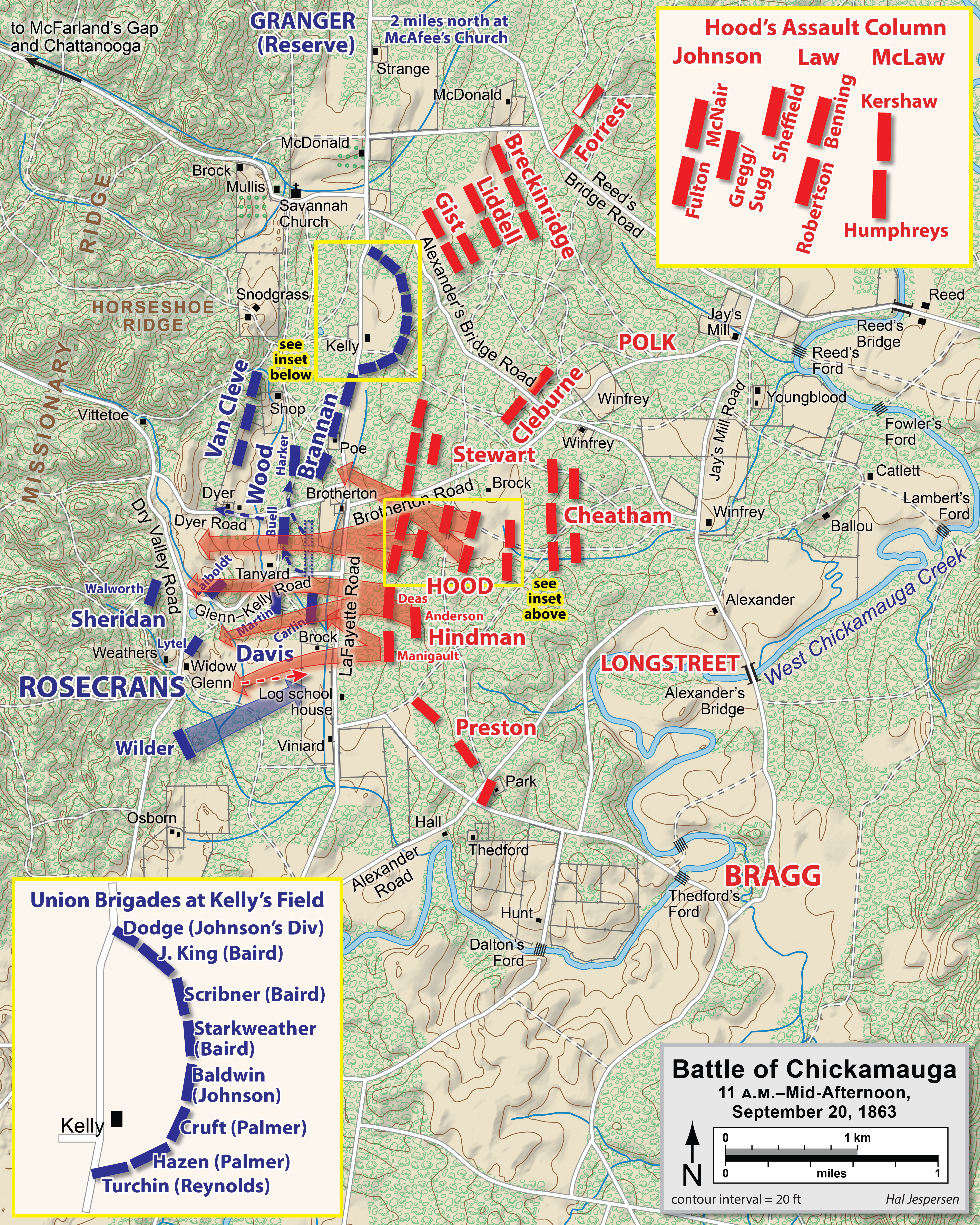
SEPTEMBER 20, 1863:
The
Battle of Chickamauga (Day Two):
General
Braxton Bragg C.S.A. was later to report of the first day of the Battle of Chickamauga that, “Night found us masters of the ground, after
a series of very obstinate contests with largely superior numbers," yet
Bragg had squandered a vital opportunity to defeat the Union by not pressing
his assault of the afternoon of the 19th. Although Rosecrans had
almost been overrun, Bragg had failed to reinforce his breakthrough when
attacked, and so he found himself parked essentially where he had been the day
before. Nonetheless, Bragg might have soundly
defeated the Union on the 20th. Bragg orders an attack on the Union
right flank. Unfortunately, Bragg times the attack for 9:30 A.M. The
two-and-one-half hours of daylight between dawn and the launch of the attack
give the Union troops time to reinforce their lines just where their enemies
are strongest. In the first wave, General Benjamin Hardin Helm, C.S.A., United
States President Abraham Lincoln’s favorite brother-in-law and close friend, is
killed.

A Union counterattack badly mauls the Confederates, who
regroup, and counterattack in turn. To the Confederates’ great delight, a confusion
in orders has created a mile wide gap in the Union lines, through which General
James Longstreet’s troops pour by the Division, inflicting brutal casualties on
the confused Union forces.
By 1:00 P.M., Union forces are in full retreat across the
battlefield, and the day seems lost. However, the Confederates again, cannot
provoke a rout, and the Federals are withdrawing in generally good order.
Individual Union units are holding their positions, both stalling the
Confederate advance and allowing other, disorganized units time to withdraw and
reform.
The overall Union Commander, General William Rosecrans, is
driven from the field, and orders his troopers back to Chattanooga.
Even as Rosecrans issues his order to retreat, the
Virginia-born Union General George H. Thomas rallies his men, stands his ground
at Horseshoe Ridge, and battles the Confederate forces backward, earning the
name, “The Rock of Chickamauga” for his spirited actions.
Horseshoe Ridge becomes a Union rallying point, and more and
more Union troops arrive, blasting headlong into the Confederate line. The 535
men of the 21st Ohio Regiment alone expend 43,550 rounds in the
engagement on Horseshoe Ridge.
Thomas’ brilliant holding action saves the day. Not only is
a large portion of the Union Army able to withdraw in good order, but the fight
on Horseshoe Ridge reinvigorates the Union men, who now show considerable esprit de corps in holding their
position for the remainder of the day, while driving off the Confederates. As the day wears on, the Confederate command
becomes more and more disorganized, failing to act on its advantageous positioning.
The fighting ends as the sun goes down. Thomas and the Union troops holding
Horseshoe Ridge fall back to Chattanooga.
“Taken as a whole,
the performance of the Confederate right wing this morning had been one of the
most appalling exhibitions of command incompetence of the entire Civil War.”--- Six Armies in Tennessee, Steven E. Woodworth.
 Although Chickamauga is most often considered a Confederate
victory (since the Army of The Tennessee was left largely intact and in control
of its supply lines into northern Georgia), the battle is sometimes looked at
as a tactical draw (both sides lost approximately the same percentage of men)
or even a Union strategic victory (the Union remained in control of the
Chattanooga area while inflicting casualties on the Confederacy it could no
longer replace).
Although Chickamauga is most often considered a Confederate
victory (since the Army of The Tennessee was left largely intact and in control
of its supply lines into northern Georgia), the battle is sometimes looked at
as a tactical draw (both sides lost approximately the same percentage of men)
or even a Union strategic victory (the Union remained in control of the
Chattanooga area while inflicting casualties on the Confederacy it could no
longer replace).
Even having “illegally” reinforced his Army with almost
20,000 paroled men from Vicksburg, Braxton Bragg paid a terrible price for a
very indecisive victory. In the end, almost 19,000 Confederates were killed or
wounded in the battle, along with some 16,000 Union troops. The battle is
remembered as a particularly gory engagement, with most of the troops fighting
at very close quarters.
Immediately after the battle, Bragg encamps his remaining
men atop Lookout Mountain in view of Chattanooga, but does nothing in regard to
the city, drawing accusations of cowardice from the South. In the North,
Rosecrans quickly becomes the focus of criticism and derision for abandoning
the field while the battle was still in doubt. He is quickly relieved of
command and never leads troops in battle again.
All in all, Chickamauga (which means “Dead River” or “River
of Death” in Cherokee) was another tremendously costly battle---35,000 men in
total---that, like Fredericksburg or many another engagement, acquired little
for either combatant. By losing the chance to definitively defeat the North in
this large-scale battle, the South effectively ceded the momentum of the war in
the one remaining theater where a victory may have influenced the outcome of
the entire war.